If you’re considering breast implants, understanding the differences between silicone vs saline breast implants is an important first step.
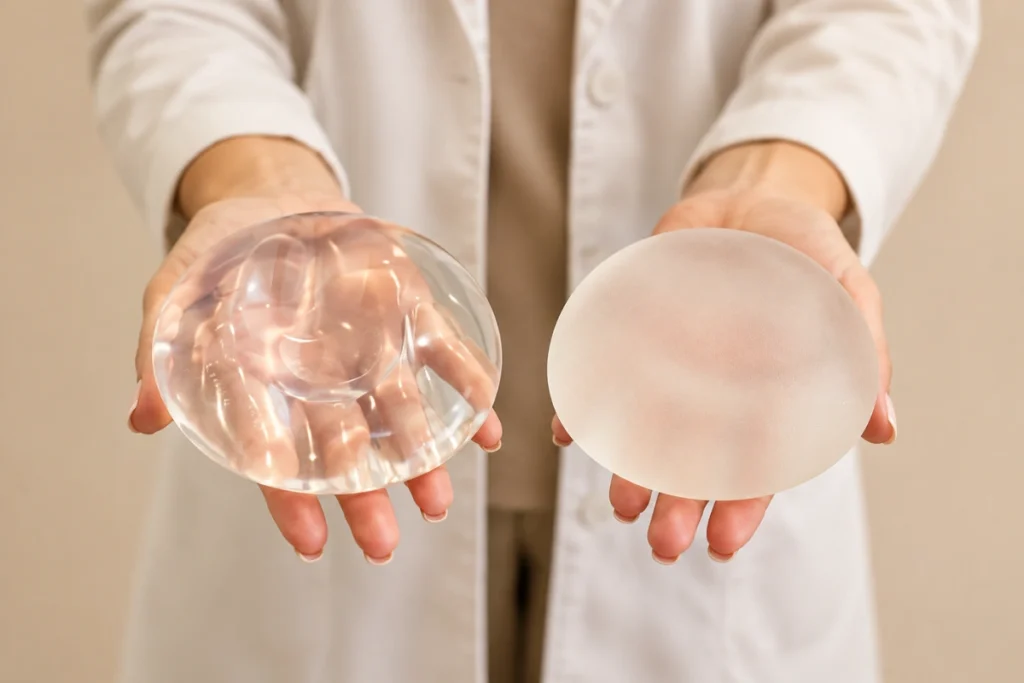
Both types have an outer silicone shell. The main difference is what is inside the implant: silicone implants contain silicone gel, while saline implants contain sterile salt water.
Neither type is automatically better for every patient.
Silicone implants are often chosen because their consistency can feel more similar to natural breast tissue, while saline implants have the advantage that a rupture is usually easier to notice because the implant deflates. The right choice depends on factors such as your existing breast tissue, desired feel and appearance, implant size and profile, willingness to undergo future imaging, and your surgeon’s assessment.
Silicone and saline implants offer different benefits and considerations. Understanding their differences can help you have a more informed conversation with your surgeon
What Are Silicone Breast Implants?
Silicone breast implants consist of a silicone outer shell filled with silicone gel.
Modern silicone implants are available in different:
- sizes
- profiles
- shapes
- levels of gel cohesiveness
- shell surfaces, depending on the device
The gel varies in firmness depending on the implant design. Some implants contain a softer gel, while more cohesive implants maintain their shape more firmly.
The American Society of Plastic Surgeons notes that silicone gel generally feels more similar to natural breast tissue than saline.
One important difference, however, is what happens if the implant shell ruptures.
Unlike saline implants, silicone implants may not visibly collapse after rupture. The gel may remain inside the implant shell or within the surrounding implant pocket, meaning a rupture can sometimes occur without obvious symptoms.
This is commonly referred to as a silent rupture.
What Are Saline Breast Implants?
Saline breast implants also have a silicone outer shell, but they are filled with sterile salt water.
If a saline implant ruptures, the saline leaks out and is absorbed by the body. The implant then loses volume and usually deflates, making the rupture much easier to recognise.
Saline implants may also be filled during surgery, depending on the device.
Because the implant can be inserted before it is filled, the incision required for some saline implants may be smaller than that required for certain pre-filled silicone implants. However, incision size also depends on implant volume, surgical technique and individual anatomy.
Saline implants are available in different sizes and profiles, but their feel and tendency to ripple can differ from silicone implants, particularly in patients with relatively little natural breast tissue.
Silicone vs Saline Breast Implants: Key Differences
The comparison below breaks down their filling, feel, appearance, rippling, rupture behaviour, monitoring, longevity, and other important factors.
| Comparison Factor | Silicone Breast Implants | Saline Breast Implants |
|---|---|---|
| Filling Material | Silicone gel | Sterile salt water |
| Outer Shell | Silicone | Silicone |
| Feel | Often softer and more similar to natural breast tissue | Can feel firmer, particularly with limited tissue coverage |
| Appearance | May appear more natural in some patients, particularly with limited tissue coverage | Can provide a balanced appearance when appropriately selected |
| Rippling | Can occur, but may be less noticeable in some patients | May be more noticeable, especially with thinner skin or less natural breast tissue |
| If Rupture Occurs | Implant may maintain its shape; gel may remain within the shell or surrounding capsule | Implant usually deflates as saline leaks out and is absorbed by the body |
| Rupture Detection | Rupture can be silent and may require imaging for detection | Rupture is usually easier to recognise because the implant deflates |
| Routine Rupture Monitoring | Periodic ultrasound or MRI is recommended for silicone gel implants | Routine screening specifically for silent rupture is generally not required |
| Volume Adjustment During Surgery | Pre-filled | Some saline implants can be filled during surgery |
| Natural Tissue Coverage | May be considered when natural breast tissue is limited because gel can feel more tissue-like and may show less rippling | Rippling may be more noticeable when there is limited tissue coverage |
| Implant Profile & Dimensions | Available in different sizes, profiles, shapes and gel cohesiveness | Available in different sizes and profiles |
| Longevity | No fixed lifespan; may require removal or replacement due to rupture, complications, changes in shape or preference | No fixed lifespan; may require removal or replacement for similar reasons |
| Breast Implant Risks | Risks can include rupture, capsular contracture, asymmetry, infection, pain, rippling and additional surgery | Risks can include rupture/deflation, capsular contracture, asymmetry, infection, pain, rippling and additional surgery |
| Implant Surface | Surface characteristics vary by device; certain textured surfaces have specific risks | Surface characteristics vary by device; risks depend on the specific implant surface |
| Silicone-Free? | No, filling and shell are silicone | No, saline filling is inside a silicone shell |
This table gives a general overview, but implant type is only one part of the decision. Implant width, profile, volume, placement and your natural breast tissue can have just as much influence on the final appearance.
Which Feels More Natural: Silicone or Saline?
When patients compare silicone implant feel vs saline implant feel, silicone is often described as feeling more similar to natural breast tissue.
This is because cohesive silicone gel has a consistency that more closely resembles soft breast tissue than salt water. The effect may be particularly noticeable in someone who has relatively thin breast tissue covering the implant.
Saline implants can sometimes feel firmer or show more movement of the fluid inside the shell.
However, the final feel depends on more than the implant filling.
Important factors include:
- amount of natural breast tissue
- implant placement
- implant size
- implant profile
- skin thickness
- implant shell characteristics
- degree of capsular tissue around the implant
A silicone implant therefore does not guarantee that the breast will feel completely natural, just as saline does not necessarily feel unnatural in every patient.
Which Implant Looks More Natural?
There is no single implant type that will always look more natural.
Silicone implants may have an advantage in patients with limited tissue coverage because they can be less likely to show visible rippling compared with saline.
However, appearance also depends heavily on:
- implant dimensions
- chest width
- existing breast shape
- skin quality
- amount of breast tissue
- implant position
- surgeon technique
A well-selected saline implant in an appropriate patient may produce a balanced result, while a poorly chosen silicone implant may look disproportionate.
This is why choosing the correct implant should not be based on filling material alone.
What Is Rippling?
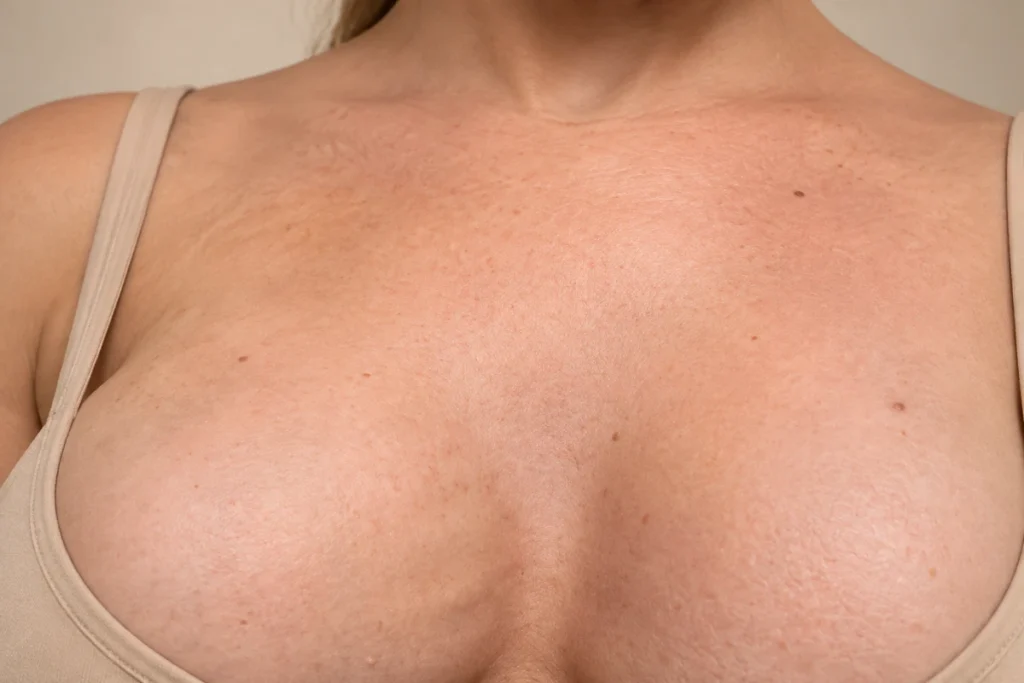
Rippling refers to visible or palpable folds or wrinkles in the implant shell.
Both silicone and saline implants can ripple, but saline implants may be more likely to show rippling in patients with thinner skin or less natural breast tissue.
Rippling may be more noticeable:
- along the outer breast
- towards the lower breast
- in thin patients
- when an implant is relatively large compared with the available tissue coverage
Implant placement and the thickness of tissue over the implant also affect how visible or palpable these folds may be.
If rippling is a concern for you, it is worth discussing both your implant type and implant dimensions during consultation.
What Happens If a Saline Implant Ruptures?
A saline rupture is usually relatively obvious.
If the outer silicone shell develops a tear or hole, the saline gradually or sometimes rapidly leaks out.
The body absorbs the sterile saline, while the affected breast loses volume as the implant deflates.
You may notice:
- a reduction in breast size
- change in shape
- asymmetry between the breasts
- gradual or sudden deflation
The saline itself is absorbed by the body, but the ruptured implant shell remains and typically requires surgical evaluation.
What Happens If a Silicone Implant Ruptures?
A rupture involving a silicone implant can be more difficult to detect.
The cohesive gel may remain partly inside the implant shell or stay within the surrounding capsule.
Because of this, the implant may continue to look and feel relatively normal.
The FDA describes many silicone implant ruptures as silent ruptures, meaning neither the patient nor the healthcare professional may immediately notice them through examination alone.
Some patients may still develop symptoms such as:
- change in breast shape
- uneven appearance
- firmness
- pain or tenderness
- swelling
- lumps
- altered sensation
If rupture is suspected, imaging may be needed to assess the implant.
Do Silicone Implants Need MRI or Ultrasound Monitoring?
This is one of the most important practical differences between saline vs silicone implants.
Because silicone rupture may be silent, the FDA recommends periodic imaging for patients with silicone gel-filled implants.
For people without symptoms, current FDA labelling recommendations advise a first ultrasound or MRI at approximately 5–6 years after implantation, followed by imaging every 2–3 years thereafter. If symptoms develop or ultrasound findings are unclear, MRI may be recommended.
Saline implants do not have the same routine rupture-screening recommendation because a rupture usually produces noticeable deflation.
This does not replace routine breast health screening such as mammography when medically indicated.
Are Silicone Breast Implants Safe?
Both silicone and saline implants are medical devices and both carry risks.
The FDA emphasises that breast implants are not lifetime devices. The longer implants remain in place, the greater the possibility that complications may develop and additional surgery may eventually be required.
Potential complications associated with breast implants include:
- capsular contracture
- rupture or deflation
- breast or implant asymmetry
- infection
- pain
- changes in sensation
- implant displacement
- wrinkling or rippling
- additional surgery
- implant removal or replacement
There are also rare implant-associated conditions that should be discussed during informed consent.
For example, breast implant-associated anaplastic large cell lymphoma, or BIA-ALCL, has been associated particularly with certain textured implant surfaces rather than simply whether the implant contains silicone or saline.
This is an important distinction.
When comparing breast implants, patients should ask about both the implant filling and the implant surface or specific device being proposed.
Does Saline Mean the Implant Is Silicone-Free?
No.
This is a common misunderstanding.
Although saline implants are filled with sterile salt water, their outer shell is still made from silicone.
The phrase “saline implant” refers to the material inside the shell, not the material of the entire implant.
Therefore, someone specifically wishing to avoid all silicone materials should discuss this carefully with their surgeon rather than assuming a saline implant contains no silicone.
Benefits of Silicone Breast Implants
Potential silicone implant benefits include:
- a consistency that often feels more similar to natural breast tissue
- potentially less noticeable rippling in patients with limited tissue coverage
- multiple levels of gel cohesiveness
- a wide range of implant profiles and designs
- good shape retention with modern cohesive gels
However, silicone implants also have limitations.
The most important is that rupture may not be obvious, meaning long-term imaging surveillance needs to be considered.
Benefits of Saline Breast Implants
Potential saline implant benefits include:
- rupture is usually easier to detect
- sterile saline is absorbed by the body if the implant deflates
- some devices allow volume adjustment during surgery
- no routine imaging programme specifically for silent rupture is generally required
Potential limitations include:
- more noticeable rippling in some patients
- a potentially firmer or less tissue-like feel
- visible deflation if rupture occurs
Again, these are general differences rather than guarantees of how an implant will behave in a specific person.
Which Implant Is Better if You Have Very Little Breast Tissue?
Patients with relatively thin skin or limited natural breast tissue may be more likely to notice implant edges or rippling.
Because silicone gel tends to feel more like breast tissue and may show less rippling than saline in some patients, silicone implants are often considered when soft-tissue coverage is limited.
However, implant placement and size are also important.
Choosing an implant that is too wide or too large for the available tissue can increase visibility regardless of the filling material.
Your surgeon therefore needs to assess:
- breast tissue thickness
- breast width
- skin quality
- chest proportions
- implant dimensions
before deciding which implant may be appropriate.
Does One Implant Type Last Longer?
Patients sometimes ask whether silicone or saline implants last longer.
There is no fixed lifespan that applies to every implant.
The FDA specifically advises patients that breast implants should not be considered lifetime devices. The likelihood of needing another procedure increases the longer implants remain in place.
Implants are not automatically replaced on a specific anniversary simply because a certain number of years has passed.
Replacement may be considered because of:
- rupture
- deflation
- capsular contracture
- implant displacement
- changes in breast shape
- patient preference
- another complication
The best approach is ongoing follow-up rather than assuming every implant must be replaced after exactly 10 years.
Silicone vs Saline: Which Is Better for You?
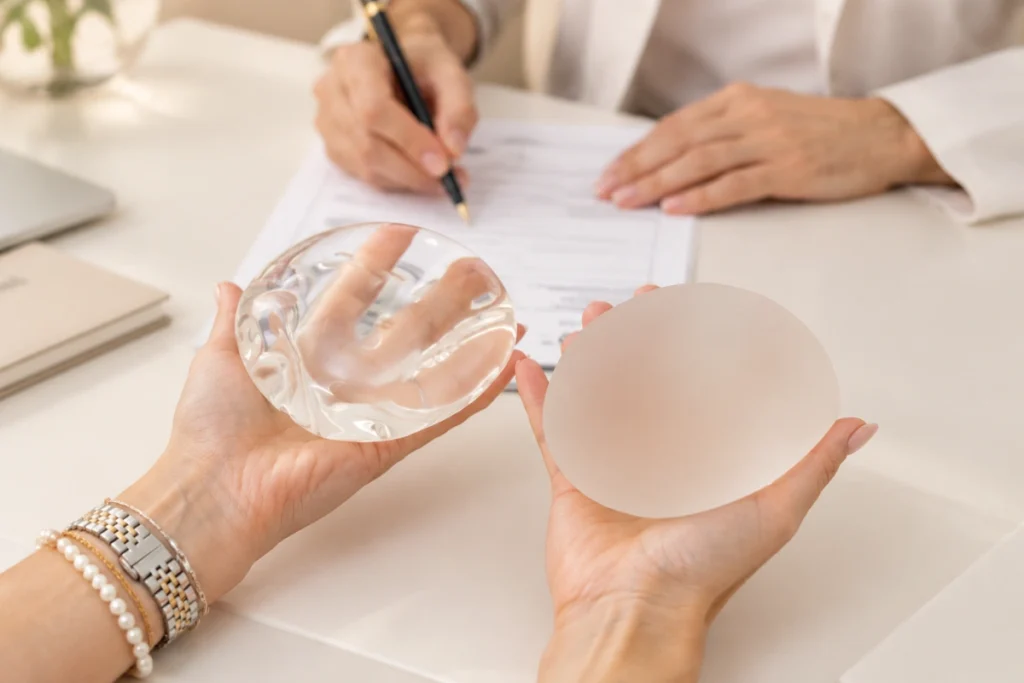
Instead of asking “Which implant is better?”, a more useful question is:
“Which implant characteristics are better suited to my anatomy, priorities and expectations?”
For example:
- You may place more importance on a softer feel: Silicone may be worth discussing.
- You are particularly concerned about detecting rupture easily: Saline may appeal because deflation is usually visible.
- You have relatively little natural breast tissue: Your surgeon may discuss whether silicone could reduce the risk of noticeable implant edges or rippling.
- You want to avoid periodic implant imaging: This may influence your decision because silicone implants require additional surveillance for silent rupture.
- You want a particular breast shape or projection: Implant dimensions and profile may matter more than whether the implant is saline or silicone.
There is rarely one isolated factor that determines the decision.
What Should You Discuss During Your Consultation?
Patients considering breast surgery in Dubai should use the consultation to compare the breast implant types in the context of their own anatomy rather than relying only on online photographs or another patient’s experience.
Useful questions include:
- Which implant type do you recommend for my breast tissue?
- What difference would I notice?
- Am I likely to experience rippling?
- Which implant profile suits my chest width?
- What happens if this implant ruptures?
- How would I know if a rupture has occurred?
- Will I require routine ultrasound or MRI?
- What implant surface is being recommended?
- What are the device-specific risks?
- How long should I expect to monitor these implants?
- Under what circumstances might they need to be removed or replaced?
If you would like to understand how implants fit into the overall procedure, you can also read about breast augmentation.
Silicone or Saline? There Is No Universal “Better” Implant
The comparison between silicone vs saline breast implants is not simply about choosing one material over another.
Silicone implants often provide a softer, more tissue-like feel and may reduce visible rippling in some patients. Saline implants make rupture easier to recognise because the implant generally deflates.
At the same time, silicone implants require consideration of long-term ultrasound or MRI surveillance because rupture may occur without obvious symptoms.
The right decision depends on your breast tissue, chest dimensions, preferred appearance and feel, implant size and profile, willingness to undergo future monitoring, and your surgeon’s assessment.
If you are unsure which type may suit your anatomy and goals, speak with a qualified specialist at La Clinique for an individual assessment and a clear discussion of the benefits, limitations and long-term considerations of each option.