If you are researching rhinoplasty, you may come across two terms repeatedly: open rhinoplasty and closed rhinoplasty.
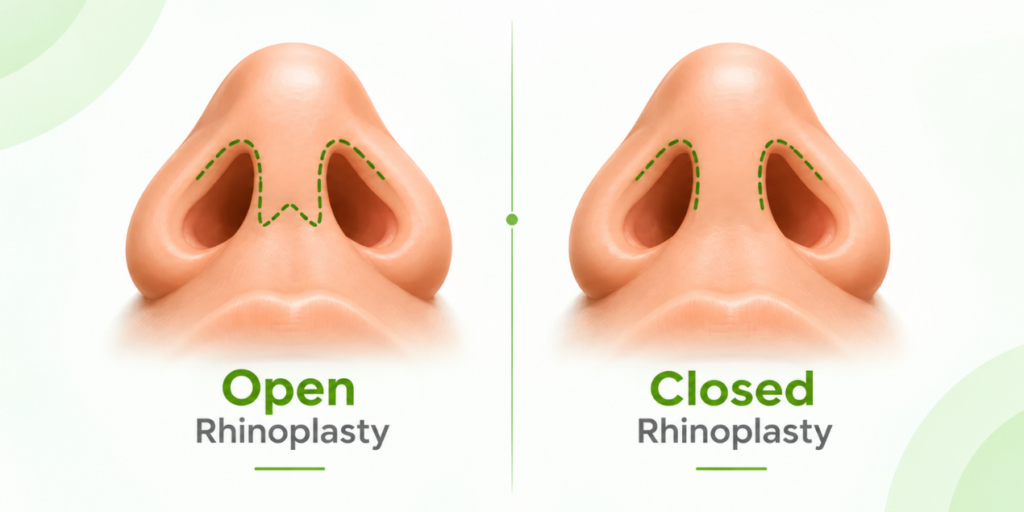
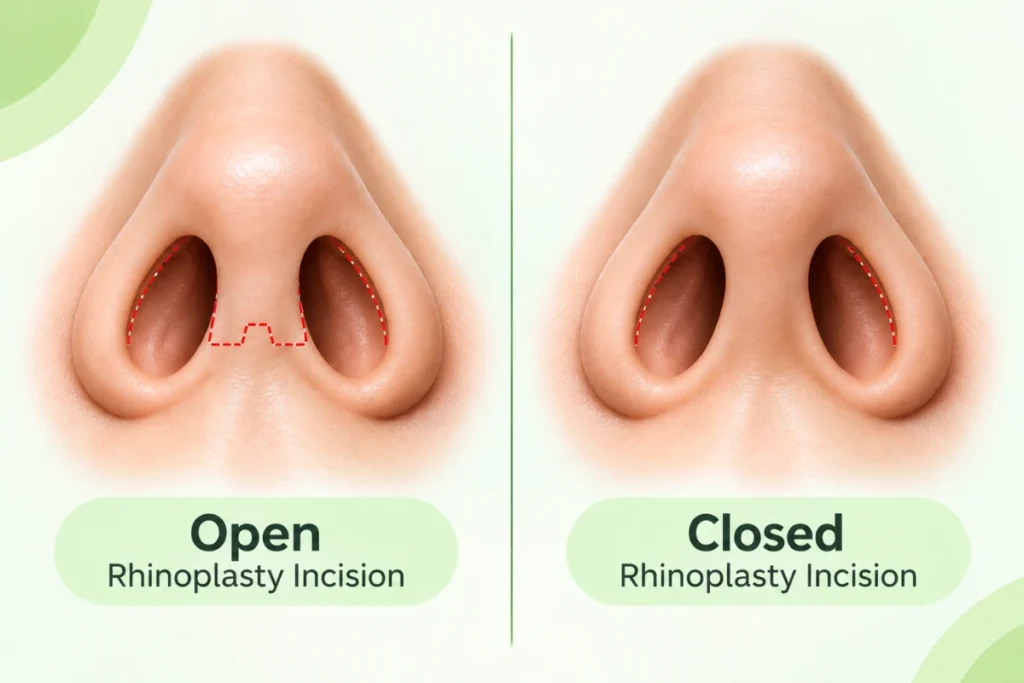
The main difference is the surgical access. In open rhinoplasty, the surgeon makes incisions inside the nose along with a small incision across the columella the strip of tissue between the nostrils. In closed rhinoplasty, the surgical incisions are made inside the nostrils, without the external columellar incision.
Both approaches allow the nasal bones and cartilage to be reshaped. The choice between open vs closed rhinoplasty depends on factors such as your nasal anatomy, the changes required, whether grafting or detailed tip work is planned, previous nasal surgery and the surgeon’s preferred technique.
Importantly, one approach is not automatically better than the other. The most appropriate technique is the one that gives the surgeon suitable access to make the planned changes safely and precisely.
Every nose is different. Understanding open and closed rhinoplasty helps you understand how surgical access, precision, recovery, and your individual anatomy shape the treatment plan.
What Is Open Rhinoplasty?
Open rhinoplasty, also called an external rhinoplasty approach, involves incisions inside the nostrils and an additional small incision across the columella.
The nasal skin and soft-tissue envelope can then be carefully elevated, giving the surgeon direct visual access to much of the underlying cartilage and bony framework.
This increased exposure is one of the main advantages of the open rhinoplasty technique. It can be particularly useful when surgery requires detailed assessment and modification of the nasal framework.
Depending on the individual case, an open approach may be considered when:
- significant nasal tip reshaping is required
- the nose has considerable asymmetry
- cartilage grafts need precise placement
- structural support needs to be reconstructed
- the anatomy is complex
- previous surgery has altered the normal nasal anatomy
However, having an open procedure does not necessarily mean that the operation is “better” or that the patient’s concerns are more severe. It simply describes how the surgeon accesses the nasal structures.
What Is Closed Rhinoplasty?
Closed rhinoplasty, also known as an endonasal approach, is performed through incisions made within the nostrils.
There is no transcolumellar incision across the external skin between the nostrils. Through these internal incisions, the surgeon can access and modify selected areas of nasal bone and cartilage.
The closed rhinoplasty technique can be used for a range of changes, including certain modifications of the nasal bridge and tip. However, compared with an open approach, the surgeon works through a more limited surgical exposure.
Whether that is a disadvantage depends entirely on what needs to be done.
For an appropriately selected case, an experienced surgeon may be able to achieve the planned changes through a closed approach without needing the additional external incision.
Open vs Closed Rhinoplasty: A Quick Comparison
The most obvious difference is the location of the incisions, but surgical visibility and access also differ.
| Open Rhinoplasty | Closed Rhinoplasty | |
| Incisions | Inside the nose plus a small columellar incision | Inside the nostrils |
| External columellar scar | Yes | No |
| Exposure of nasal framework | Greater direct exposure | More limited exposure |
| Tip access | Allows extensive visualisation and modification | Tip work is possible, but through internal access |
| Complex structural work | May provide advantages when extensive reconstruction or grafting is required | Can be suitable when planned changes can be performed through internal access |
| Soft-tissue dissection | Generally more extensive | Generally less extensive |
| Swelling | Can involve prolonged tip swelling in some cases | May involve less early soft-tissue swelling in appropriately selected cases |
| Best approach | Depends on anatomy and surgical goals | Depends on anatomy and surgical goals |
This comparison is helpful, but it should not be used as a checklist for choosing your own surgical technique. Rhinoplasty involves multiple structures that influence one another, so the approach needs to match the actual surgical plan.
What Is the Difference Between Open and Closed Rhinoplasty Incisions?
The rhinoplasty incision technique is one of the clearest differences between the two approaches.
For more information on how the two approaches are performed, see this guide to open and closed rhinoplasty procedures from the American Society of Plastic Surgeons.
Open Rhinoplasty Incisions
With an open approach, incisions are made inside the nose and connected through a small incision across the columella. The surgeon then carefully lifts the skin and soft tissues to expose the underlying nasal framework.
This allows the cartilage and other structures to be viewed directly while they are being modified.
Closed Rhinoplasty Incisions
With a closed approach, the incisions remain inside the nostrils. The surgeon accesses the nasal structures through these internal incisions without lifting the nasal skin in the same way as with an open approach.
Therefore, there is no external transcolumellar incision.
Does Open Rhinoplasty Leave a Scar?
Yes, open rhinoplasty leaves a small scar on the outside of the nose. The incision is carefully placed and closed. In many people, the scar becomes less noticeable as it heals, but healing is different for everyone.
Factors such as skin type, healing, surgical technique, and aftercare can affect how the scar looks.
It is better to say that an open rhinoplasty scar is designed to be discreet, rather than saying it will be completely invisible.
Does Closed Rhinoplasty Leave a Scar?
With closed rhinoplasty, the cuts are made inside the nostrils, so there is no scar on the outside of the nose. However, this does not mean there is no scarring at all.
Like any surgery, the cuts heal and form scar tissue. With closed rhinoplasty, these scars are usually inside the nose.
In some cases, additional cuts may be needed for other changes, such as reshaping the nostril base. These may be made outside the nose, whether the main rhinoplasty approach is open or closed.
Is Open Rhinoplasty Better for Complex Nose Reshaping?
An open approach can be useful for cases requiring extensive structural work because it provides broad access to the nasal framework.
For example, a surgeon may favour it when performing:
- substantial tip reconstruction
- complex cartilage reshaping
- detailed graft placement
- correction of significant asymmetry
- selected revision procedures
- reconstruction of weakened nasal support
The improved exposure can make it easier to see and manipulate structures while they remain in their anatomical position. However, complexity alone does not automatically determine the approach.
A surgeon experienced in closed techniques may perform certain advanced modifications endonasally, while another surgeon may prefer an open approach for the same anatomical concern.
The surgical plan and surgeon’s expertise both matter.
Is Closed Rhinoplasty Better for Smaller Changes?
Closed rhinoplasty may be suitable when the planned changes can be done through incisions inside the nose. For example, some changes to the nasal bridge or tip can be done using a closed approach.
Because there is usually less lifting of the soft tissue, some patients may have less swelling in the early stages of recovery. However, closed rhinoplasty is not only for “minor” procedures. Experienced surgeons can perform different types of structural changes using either approach.
The right approach depends on your nasal anatomy and the changes needed, rather than simply assuming:
Closed = simple
Open = complex

Open vs Closed Rhinoplasty Recovery: Is There a Difference?
Recovery is another common consideration when comparing open vs closed nose surgery. Because an open approach generally involves greater soft-tissue dissection, swelling—particularly around the nasal tip—may persist longer in some patients.
A closed approach involves less soft-tissue elevation and has traditionally been associated with reduced postoperative swelling and potentially faster early recovery in selected cases.
However, this difference should not be overstated.
A recent systematic review and meta-analysis comparing open and closed approaches found no statistically significant differences in postoperative oedema, bruising, complication rates, patient satisfaction or measured functional and aesthetic outcomes between the techniques overall.
Recovery is influenced by much more than whether the approach is open or closed.
Factors include:
- how much bone and cartilage were modified
- whether osteotomies were required
- the amount of tip work performed
- whether grafts were used
- skin thickness
- previous nasal surgery
- individual healing response
So, while the surgical approach can influence recovery, it is only one part of the picture.
Is Open or Closed Rhinoplasty More Accurate?
Neither technique can universally be described as more accurate.
Open rhinoplasty provides greater visual exposure, which can be valuable when the surgeon needs to see and manipulate multiple structures directly.
Closed rhinoplasty provides more limited exposure but may allow the necessary changes to be made without the external columellar incision.
Recent evidence comparing outcomes is important here. A systematic review and meta-analysis involving more than 1,000 patients found no significant overall differences between open and closed techniques in patient-reported aesthetic outcomes, nasal obstruction scores, satisfaction or complication rates.
This suggests that the quality of the result cannot be predicted simply from whether the operation is labelled “open” or “closed.”
Note: Patient selection, surgical planning, the required structural changes and surgeon expertise are more meaningful considerations.
Can Both Techniques Address Breathing Problems?
Potentially, yes. Rhinoplasty is not always performed for appearance alone. Some patients also have structural concerns that affect nasal airflow.
Depending on the diagnosis and surgical plan, work on structures such as the septum or nasal valves may be incorporated into surgery.
The choice of open or closed access does not by itself determine whether functional problems can be addressed.
If breathing difficulty is part of your concern, it should be discussed separately during your assessment so the internal nasal structures and airflow can be evaluated.
How Does a Surgeon Decide Between Open and Closed Rhinoplasty?
There is no single rule that determines the correct approach. Before recommending a technique, the surgeon may consider:
1. Nasal Tip Anatomy
If extensive tip reshaping or reconstruction is needed, greater exposure may be useful.
2. Nasal Bridge
The surgeon will assess the height, width, contour and symmetry of the bridge and determine which modifications are required.
3. Structural Support
The strength and position of the nasal cartilage matter because changes to one structure can influence other parts of the nose.
4. Need for Grafting
Cartilage grafts may be used to support or reshape specific areas. The number, location and complexity of these grafts may influence the preferred approach.
5. Previous Surgery
Revision surgery can be more complex because previous procedures may have altered cartilage, created scar tissue or changed the normal anatomical planes.
6. Skin and Soft-Tissue Characteristics
Skin thickness and soft-tissue characteristics influence both surgical planning and how changes to the underlying framework may appear externally.
7. Functional Concerns
Breathing problems, septal deviation or other structural issues should be considered alongside aesthetic goals.
8. Surgeon Experience
Surgeons develop expertise with particular rhinoplasty techniques. A technique that provides excellent access and control in one surgeon’s hands may differ from another surgeon’s preferred approach.
The aim should therefore be to choose the technique that best supports the surgical plan—not to choose a technique simply because it sounds more advanced or less invasive.
Benefits and Limitations of Open vs Closed Rhinoplasty
Potential Advantages of Open Rhinoplasty
- greater direct exposure of nasal anatomy
- detailed visualisation of the nasal tip structures
- useful access for complex structural modifications
- can facilitate precise placement of certain grafts
- useful in selected revision and reconstructive cases
Potential Limitations of Open Rhinoplasty
- requires an external columellar incision
- greater soft-tissue dissection
- tip swelling may take longer to settle in some patients
- the external scar requires time to mature
Potential Advantages of Closed Rhinoplasty
- all standard approach incisions are inside the nostrils
- no transcolumellar scar
- less extensive soft-tissue elevation
- may offer less early swelling in selected cases
Potential Limitations of Closed Rhinoplasty
- more restricted surgical exposure
- some complex structural changes may be more technically demanding through internal access
- may not be the surgeon’s preferred approach when extensive reconstruction is required
Neither list means that one technique is safer or produces better results for every patient.

Which Rhinoplasty Technique May Be Right for You?
Patients researching facial surgery in Dubai may understandably arrive at a consultation already thinking they want either an open or closed approach. It is usually more useful to explain what you want to change about your nose rather than deciding on the incision technique yourself.
For example, discuss concerns such as:
- “I feel my nasal tip looks too wide.”
- “My nose looks crooked from the front.”
- “I have a prominent bridge.”
- “My tip lacks definition.”
- “I have difficulty breathing through my nose.”
- “I have already had nasal surgery.”
- “I want a subtle change without altering the character of my face.”
The surgeon can then assess your nose and explain which approach provides appropriate access for those goals.
What Should You Ask Before Rhinoplasty?
Instead of asking only, “Will my surgery be open or closed?”, consider asking:
- Why do you recommend this approach for my nose?
- What structures need to be changed?
- Will you need to modify my nasal tip?
- Will cartilage grafting be required?
- Where will my incisions be?
- Will there be an external scar?
- How much swelling should I expect?
- Are there structural issues affecting my breathing?
- What are the limitations of the proposed approach?
- What risks are relevant to my particular surgery?
These questions help you understand the reasoning behind the surgical plan rather than focusing on the name of the technique.
Choosing the Right Rhinoplasty Approach
The main difference between open vs closed rhinoplasty is how the surgeon reaches the structures inside the nose.
Open rhinoplasty uses an additional small incision on the columella, which gives the surgeon greater direct access to the nasal framework. Closed rhinoplasty uses incisions inside the nostrils and does not require an external columellar incision.
Both approaches are well-established, and current evidence does not show that one approach consistently provides better aesthetic or functional results for everyone.
The right approach depends on your nasal anatomy, the changes needed, breathing concerns, previous surgery, and the surgeon’s experience. Rather than focusing only on whether the procedure is open or closed, your surgeon should choose the approach that provides the right access for your specific surgical plan.
Not sure whether open or closed rhinoplasty is right for you? Explore our rhinoplasty procedure and speak with a qualified specialist to understand which approach may suit your needs.